
- English
- Español
- Português
- русский
- Français
- 日本語
- Deutsch
- tiếng Việt
- Italiano
- Nederlands
- ภาษาไทย
- Polski
- 한국어
- Svenska
- magyar
- Malay
- বাংলা ভাষার
- Dansk
- Suomi
- हिन्दी
- Pilipino
- Türkçe
- Gaeilge
- العربية
- Indonesia
- Norsk
- تمل
- český
- ελληνικά
- український
- Javanese
- فارسی
- தமிழ்
- తెలుగు
- नेपाली
- Burmese
- български
- ລາວ
- Latine
- Қазақша
- Euskal
- Azərbaycan
- Slovenský jazyk
- Македонски
- Lietuvos
- Eesti Keel
- Română
- Slovenski
- मराठी
- Srpski језик

How Do Cotton Slippers Maintain Foot Warmth in Cold Indoor Environments?
Cold indoor environments are not the same as outdoor cold. A room at 12°C with a concrete floor can chill the feet faster than a dry outdoor temperature of 5°C, because the floor conducts heat away and the still air does not replace the warm layer around the skin. Cotton Slippers maintain foot warmth in this environment through three mechanisms: a trapped air layer inside the textile structure, a low-conductivity sole that separates the foot from the cold floor, and a moisture management system that keeps the insulating layer dry. A slipper that provides only thickness without these mechanisms will feel warm at first and then cold as moisture accumulates or the air layer collapses.
This guide is written for procurement teams sourcing Cotton Slippers for retail, hospitality, healthcare, or institutional use. It explains the physical mechanisms of warmth, the material and construction parameters that determine insulation, the role of moisture and fit, the sole and floor interaction, and the verification steps that should be completed before an order is placed. The content is organized so that each section can be used as a standalone reference for a specific procurement question. It includes the product parameters and documentation that a reliable supplier should provide. Our factory at Cixi Lesijia Shoes Co., Ltd. produces Cotton Slippers for cold indoor environments, and the guidance below reflects the design and procurement standards we apply to the products we supply.
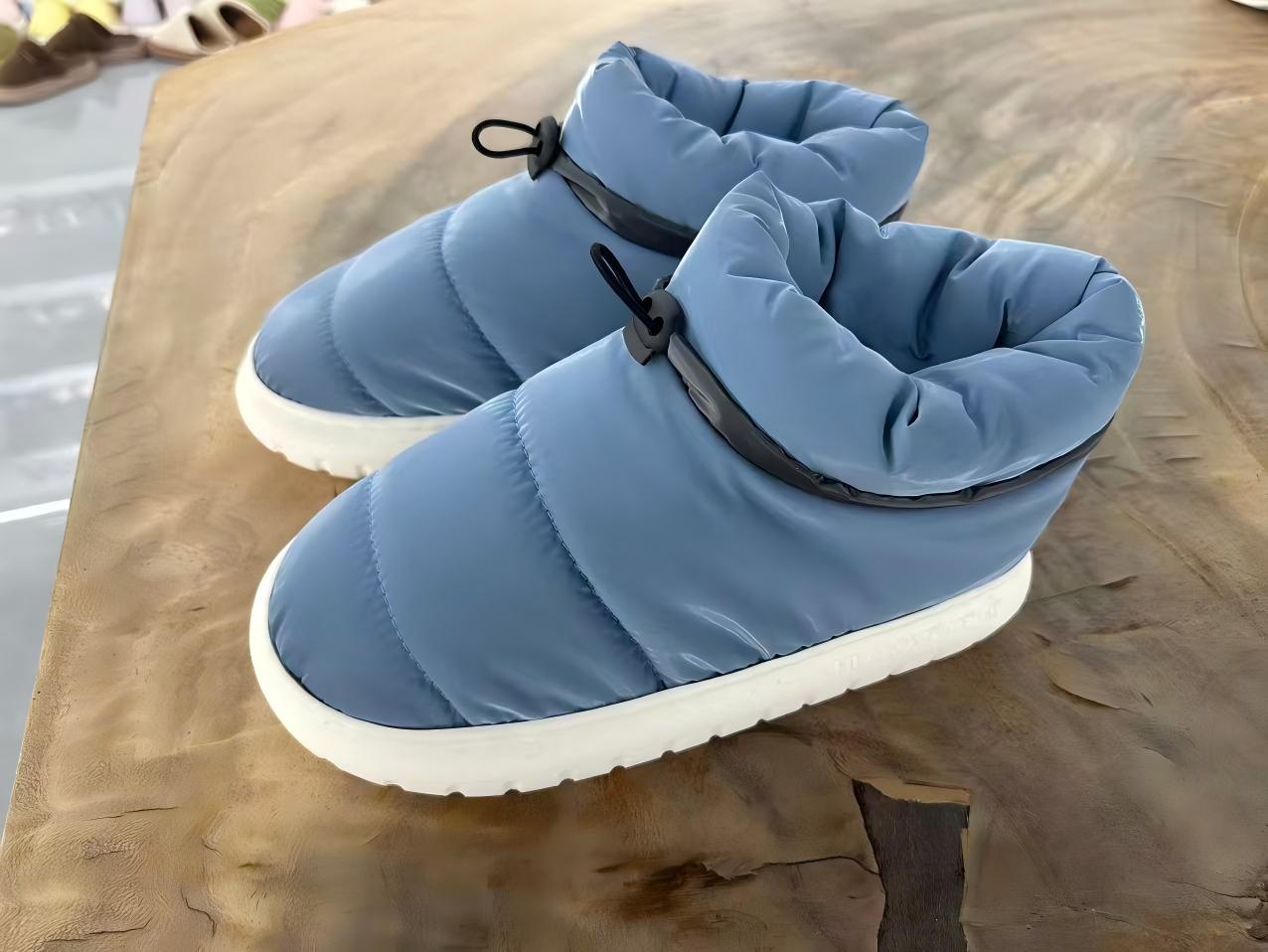
Table of Contents
- 1. What Physical Mechanisms Keep a Foot Warm Inside a Cotton Slipper?
- 2. How Do Material and Construction Choices Determine Insulation?
- 3. Which Measurable Parameters Predict Warmth Performance?
- 4. Why Does Moisture Management Decide Whether Warmth Lasts?
- 5. How Do Sole Design and Fit Affect Perceived Warmth?
- 6. What Should Buyers Verify Before Ordering Cotton Slippers?
- 7. Frequently Asked Questions (FAQ)
- 8. Conclusion
1. What Physical Mechanisms Keep a Foot Warm Inside a Cotton Slipper?
The first mechanism is the trapped air layer. Cotton fiber is not a good insulator by itself; the insulation comes from the air that is held between the fibers and between the yarns. A cotton slipper with an open, lofty structure holds more air than a dense, tightly woven slipper. The air reduces conduction and convection between the skin and the environment, and it slows the heat loss from the foot. The second mechanism is the separation from the floor. The sole is the component that breaks the conductive path to the cold floor. A sole with low thermal conductivity and sufficient thickness keeps the foot from losing heat to the slab. The third mechanism is moisture management. Cotton absorbs moisture, and a damp cotton layer conducts heat much faster than a dry one. A slipper that wicks moisture away from the skin and allows it to evaporate maintains the insulating air layer for a longer period.
The narrative below follows the heat path from the foot to the room and identifies where each mechanism acts.
- Skin to lining: The lining contacts the skin. A brushed or looped lining creates a soft, high-surface-area layer that traps air next to the skin and reduces the initial chill.
- Lining to fill: The fill is the main insulating layer. Its thickness and loft determine the air volume. A needled felt or a layered wadding provides a stable air volume that does not collapse under the foot.
- Fill to upper: The upper protects the fill from compression and from drafts. A tightly woven cotton upper with a brushed inner surface reduces air movement and keeps the fill in place.
- Upper to room: The outer surface loses heat by convection and radiation. A dense outer fabric reduces convection, and a dark or reflective surface can reduce radiation loss.
- Foot to floor: The sole is the conductive bridge. A thick, low-conductivity sole with an air cell or a foam layer reduces the heat flow to the floor.
The key point for a buyer is that warmth is a system property. A thick fill with a thin sole will lose heat to the floor. A thick sole with a thin, dense fill will lose heat through the upper. The Cotton Slippers that perform well in cold indoor environments are the ones that balance all three mechanisms. At Cixi Lesijia Shoes Co., Ltd., we design our Cotton Slippers around this balance, and we test the complete assembly rather than the individual components.
A simple field observation illustrates the system effect. Two slippers with the same fill weight can feel different on a cold tile floor if one has a 10 mm EVA sole and the other has a 20 mm EVA sole with a cork midlayer. The thicker sole reduces the conductive loss, and the foot stays warmer even though the upper is identical. This is why a buyer should evaluate the sole and the fill together, not as separate line items.
2. How Do Material and Construction Choices Determine Insulation?
Material and construction choices determine insulation because they control the air volume, the moisture behavior, and the structural stability of the slipper. The main material decisions are the lining, the fill, the upper, and the sole. The main construction decisions are the fill attachment, the quilting pattern, and the edge finishing. The table below compares the common options and their effect on warmth.
| Component | Option | Effect on Warmth | Procurement Note |
| Lining | Brushed cotton, looped terry, fleece | Brushed and looped linings trap air next to the skin | Check the brushing density and the wash durability |
| Fill | Needled felt, layered wadding, cotton batting | Loft and thickness determine air volume | Check the fill weight and the compression recovery |
| Upper | Dense cotton canvas, quilted cotton, knit | Dense upper reduces convection; quilted upper adds air pockets | Check the air permeability and the seam strength |
| Sole | EVA, TPR, rubber, felt with anti-slip | Low-conductivity thick sole reduces floor heat loss | Check the thickness, the hardness, and the slip resistance |
| Construction | Stitched channels, quilted pattern, bonded fill | Stable fill prevents cold spots and compression | Check the stitch density and the fill migration |
The fill is the most important single component for warmth, but it is not the only one. A needled felt with a high compression recovery keeps its loft under the foot, while a loose wadding compresses and loses air volume. A quilted upper with a stitched channel pattern prevents the fill from shifting and creating thin spots. A dense cotton upper reduces the convective loss through the outer surface. The sole must be thick enough to reduce conduction, but not so stiff that it reduces the contact area and creates pressure points. Our factory at LSJA selects the fill and the construction for each Cotton Slippers model based on the target room temperature and the intended use, and we test the compression recovery and the thermal performance of the assembly.
A buyer should also consider the washability of the materials. A Cotton Slipper that is washed frequently will lose loft if the fill is not designed for washing. A needled felt with a stabilizing scrim and a stitched channel construction survives washing better than a loose wadding. The procurement specification should state the expected wash cycles and the fill performance after washing. A supplier that provides the wash test data is a supplier that is managing the warmth performance over the product life.
3. Which Measurable Parameters Predict Warmth Performance?
The measurable parameters that predict warmth performance are the thermal resistance, the fill weight, the thickness, the air permeability, the moisture regain, and the compression recovery. These parameters can be specified and tested, and they allow a buyer to compare suppliers on a common basis. The table below presents the parameters with the typical ranges for cold indoor Cotton Slippers.
| Parameter | Typical Range | What It Predicts | Test Method or Evidence |
| Thermal resistance of the assembly | 0.15 to 0.35 m2K/W | Overall insulation from foot to environment | Guarded hot plate or thermal foot model |
| Fill weight | 150 to 350 g/m2 | Air volume and loft | Weight per unit area |
| Fill thickness | 8 to 20 mm | Insulation depth | Thickness gauge at defined pressure |
| Air permeability of upper | 50 to 300 L/m2/s | Convective loss and breathability | Air permeability tester |
| Moisture regain of lining | 7 to 9 percent for cotton | Moisture buffering | Standard moisture regain test |
| Compression recovery | 70 to 90 percent | Loft retention under the foot | Cyclic compression test |
The thermal resistance is the most direct predictor, but it is not always available from a low-cost supplier. When it is not available, the fill weight, the fill thickness, and the compression recovery can be used as proxies. A slipper with a 250 g/m2 fill, a 14 mm thickness, and an 80 percent compression recovery is likely to provide better warmth than a slipper with a 150 g/m2 fill, a 9 mm thickness, and a 60 percent recovery. The air permeability of the upper is a secondary predictor: a very high permeability allows convection and reduces warmth, while a very low permeability may trap moisture and reduce warmth over time. The balance is more important than the extreme value.
At Cixi Lesijia Shoes Co., Ltd., our factory measures these parameters for our Cotton Slippers and provides the data to our customers. We also provide a thermal resistance estimate based on the assembly construction when a full thermal test is not practical. The goal is to give buyers a verifiable basis for comparing warmth performance, not just a subjective description.
4. Why Does Moisture Management Decide Whether Warmth Lasts?
Moisture management decides whether warmth lasts because water conducts heat far better than air. A dry cotton layer traps air and insulates. A damp cotton layer fills the air spaces with water and conducts heat away from the foot. The foot then feels cold even though the slipper is thick. The moisture comes from two sources: insensible perspiration from the foot and condensation from the humid indoor air. The slipper must manage both sources to maintain warmth over a wearing period of several hours.
The scenario below describes a typical wearing period and the moisture events that affect warmth.
- Hour 1: The foot is dry, and the lining is dry. The air layer in the fill provides full insulation. The foot feels warm.
- Hour 2: Insensible perspiration begins to accumulate. A breathable lining and a moisture-buffering fill absorb the moisture and keep the skin dry. The warmth is maintained.
- Hour 3: The fill approaches its moisture capacity. If the upper is highly permeable, the moisture evaporates and the warmth is maintained. If the upper is impermeable, the moisture accumulates and the warmth decreases.
- Hour 4: The fill is damp. The thermal conductivity rises, and the foot feels cold. A slipper with a moisture-wicking lining and a ventilated upper recovers faster than a slipper with a non-breathable upper.
- End of day: The slipper is removed and dried. A slipper that dries quickly returns to full insulation for the next wearing. A slipper that retains moisture loses warmth the next day.
The table below summarizes the moisture management design choices and their effect.
| Design Choice | Effect on Moisture | Effect on Warmth | Procurement Check |
| Brushed cotton lining | Wicks moisture from the skin | Keeps the skin dry, maintains warmth | Check the wicking rate |
| Needled felt fill | Buffers moisture and releases it slowly | Smooths the warmth loss over time | Check the moisture regain and drying time |
| Breathable upper | Allows evaporation | Prevents moisture accumulation | Check the air permeability |
| Non-breathable upper | Traps moisture | Reduces warmth after a few hours | Avoid for long wearing periods |
| Removable insole | Allows drying between uses | Restores warmth faster | Check the insole accessibility |
Our factory at Cixi Lesijia Shoes Co., Ltd. designs our Cotton Slippers with a moisture-buffering fill and a breathable upper for the cold indoor environment. We test the drying time and the warmth retention after a simulated wearing period. The goal is to provide a slipper that maintains warmth for the full wearing period, not just at the first touch.
For a buyer, the moisture management question should be part of the product specification. A slipper that is designed for short wearing periods may use a less breathable upper, but a slipper that is designed for all-day wear must allow moisture to escape. The procurement team should ask for the air permeability and the drying time, and should test the slipper in the intended environment before the order is placed.
5. How Do Sole Design and Fit Affect Perceived Warmth?
Sole design and fit affect perceived warmth because they determine the conductive loss to the floor and the stability of the air layer around the foot. The sole is the thermal bridge to the floor. A thin, dense sole conducts heat away quickly, and the foot feels cold even if the upper is thick. A thicker sole with a low-conductivity material, such as EVA or a felt midlayer, reduces the heat flow. The fit determines whether the air layer around the foot is stable. A slipper that is too loose allows air to circulate and the foot to lose heat by convection. A slipper that is too tight compresses the fill and reduces the air volume. The correct fit is snug but not tight, with enough room for the toes to move and the fill to remain lofted.
The decision tree below describes how a buyer should evaluate the sole and the fit for a cold indoor environment.
- If the floor is concrete or tile: Specify a sole thickness of at least 15 mm with a low-conductivity material. A felt or EVA midlayer improves the insulation.
- If the floor is wood or laminate: A 10 to 15 mm sole is usually sufficient, but the slip resistance is still required.
- If the wearer has cold feet or poor circulation: Specify a thicker sole and a higher fill weight, and consider a closed-back design that keeps the heel covered.
- If the slipper is shared or used by multiple people: Specify an adjustable closure or a stretchable upper that accommodates different foot widths without compressing the fill.
- If the slipper is used for all-day wear: Specify a breathable upper and a removable insole to allow drying and maintain the air layer.
Our factory at Cixi Lesijia Shoes Co., Ltd. offers Cotton Slippers with different sole thicknesses and fit profiles for different indoor environments. We test the thermal resistance of the sole assembly and the fit stability on a representative foot model. The goal is to provide a slipper that maintains warmth through the sole and the fit, not just through the fill.
For a buyer, the sole and fit should be specified together with the fill. A slipper with a high fill weight and a thin sole will underperform on a cold floor. A slipper with a thick sole and a loose fit will lose warmth through convection. The procurement specification should state the sole thickness, the sole material, the fit profile, and the closure type. A supplier that provides these parameters is a supplier that understands the warmth mechanism as a system.
6. What Should Buyers Verify Before Ordering Cotton Slippers?
Buyers should verify the warmth performance by combining the specification review, the sample test, and the production data. The verification should be performed before the purchase order is issued, and the results should be recorded for the supplier qualification file. The checklist below provides the verification steps.
| Verification Step | What to Request or Test | Acceptance Criterion |
| Material specification | Lining, fill, upper, sole data | Matches the target room temperature and use |
| Fill weight and thickness | Measured values at defined pressure | Within the specified range |
| Compression recovery | Cyclic compression test result | At least 70 percent after the specified cycles |
| Air permeability | Upper fabric test result | Within the specified range |
| Moisture management | Wicking rate and drying time | Supports the intended wearing period |
| Sole thermal performance | Sole thickness and material data | Matches the floor type |
| Fit and stability | Sample trial on representative users | Snug, stable, no compression of fill |
Our factory at Cixi Lesijia Shoes Co., Ltd. provides the material and performance data for our Cotton Slippers, and we support sample trials for our customers. We also provide the wash test data and the drying time. The goal is to make the verification process transparent and to give buyers the evidence they need to confirm the warmth performance before the order is placed.
For a buyer, the verification should also include a review of the production control. A slipper that performs well in the sample may underperform in production if the fill weight is not controlled or the quilting is not consistent. The procurement team should confirm the in-process inspection plan and the sampling frequency. A supplier that controls the fill weight and the quilting is a supplier that is managing the warmth performance across the production run.
7. Frequently Asked Questions (FAQ)
Question 1: What is the most important feature for warmth in cotton slippers?
Answer: The most important feature is the combination of a lofted fill and a low-conductivity sole. The fill traps air around the foot, and the sole blocks heat loss to the cold floor. A thick fill with a thin sole will still feel cold on a concrete floor. A thick sole with a compressed fill will lose warmth through the upper. The best warmth comes from a balanced design that addresses both paths.
Question 2: Do cotton slippers keep feet warm if they are not breathable?
Answer: A non-breathable cotton slipper may feel warm at first, but it will trap moisture from the foot and lose warmth after a few hours. The moisture fills the air spaces in the cotton and increases the thermal conductivity. A breathable upper and a moisture-buffering fill allow the moisture to escape and maintain the insulating air layer for a longer period. For all-day wear, breathability is essential.
Question 3: How thick should the sole be for cold indoor floors?
Answer: For a concrete or tile floor, a sole thickness of at least 15 mm with a low-conductivity material such as EVA or a felt midlayer is recommended. For a wood or laminate floor, 10 to 15 mm is usually sufficient. The sole should also provide slip resistance and should not be so stiff that it reduces the contact area and creates pressure points.
Question 4: Why do cotton slippers feel cold after a few hours even when they are thick?
Answer: The most likely reason is moisture accumulation. The foot perspires, and the moisture is absorbed by the cotton. A damp cotton layer conducts heat away from the foot, so the slipper feels cold even though it is thick. A breathable upper and a moisture-wicking lining allow the moisture to evaporate and maintain the warmth. A removable insole also helps by allowing the slipper to dry between uses.
Question 5: How should I evaluate cotton slippers before placing a bulk order?
Answer: Request the material and performance data, including the fill weight, the fill thickness, the compression recovery, the air permeability, and the sole specification. Request a sample and test it on the intended floor type for the intended wearing period. Check the fit and the stability of the fill under the foot. Confirm the production control plan for the fill weight and the quilting. A supplier that provides this data and supports the sample test is a supplier that is prepared to stand behind the warmth performance.
8. Conclusion
Cotton Slippers maintain foot warmth in cold indoor environments through a system of trapped air, floor separation, and moisture management. The fill provides the air layer, the sole blocks the conductive loss to the floor, and the breathable upper and wicking lining keep the air layer dry. A slipper that is designed around only one of these mechanisms will underperform in the others. For procurement teams, the verification should cover the material specification, the fill weight and thickness, the compression recovery, the air permeability, the sole design, and the fit. Our factory at Cixi Lesijia Shoes Co., Ltd. designs our Cotton Slippers around this system and provides the material and performance data that buyers need to confirm the warmth performance. If you are sourcing Cotton Slippers for a cold indoor environment, contact our team to discuss the target room temperature and the intended use, and to request samples and performance data.
Contact Cixi Lesijia Shoes Co., Ltd. today to discuss your Cotton Slippers requirements and to request the material, insulation, and moisture management data for your application.